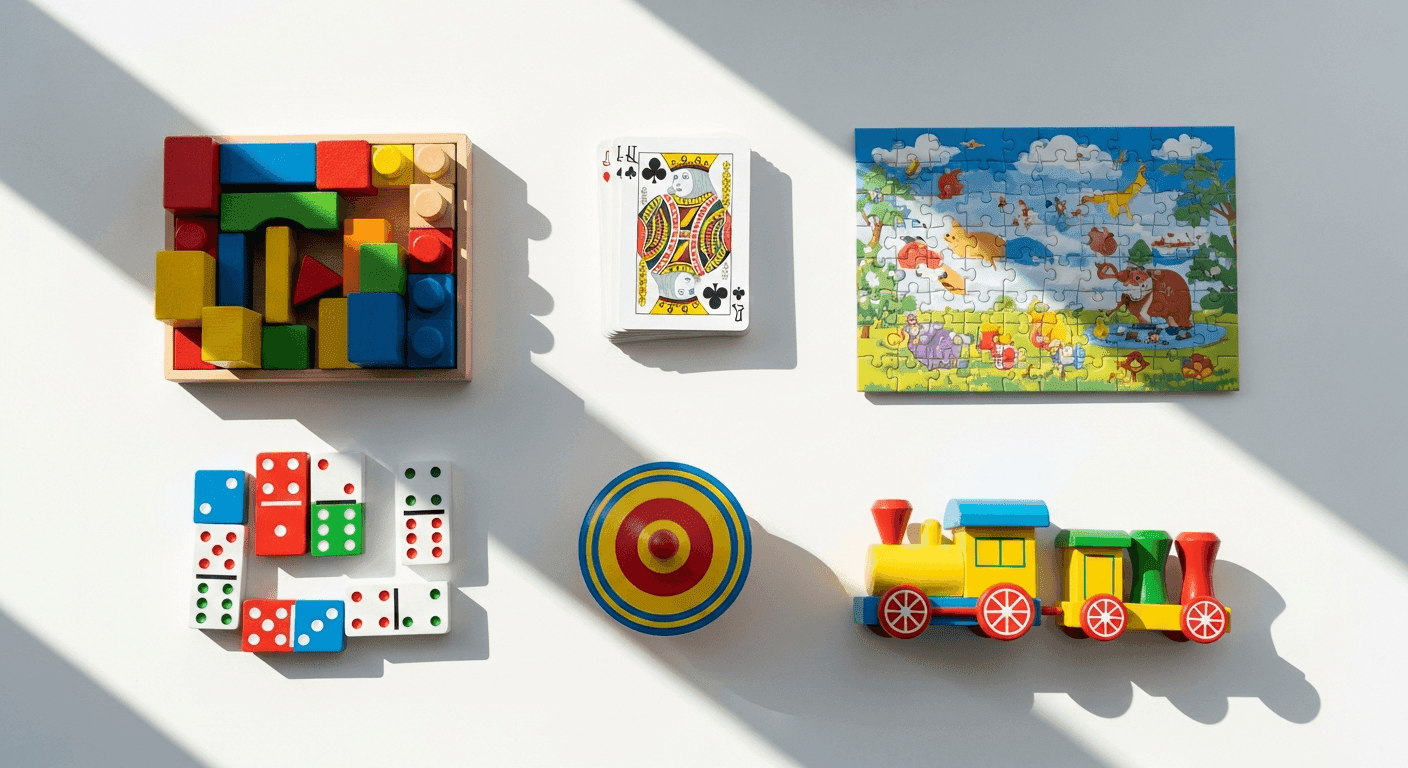
Family Fun Toys and Games Worth Your Time and Money
You've got a Saturday afternoon free, the kids are restless, and screen time has already hit its limit. Sound familiar? The difference between a dreaded afternoon and an actually fun one often comes down to having the right toy or game on hand—something engaging enough to hold attention, flexible enough to work for different ages, and ideally, something that brings people together rather than isolating them in separate corners. The problem is that not all family entertainment is created equal. Some toys lose their appeal after 20 minutes. Some games have rules so complicated you need a law degree to play them. Some collections gather dust because they're either too babyish or too advanced.
What separates the genuinely great family toys and games from the mediocre ones is durability—both physical and psychological. Great products hold up to repeated use, stay engaging across multiple play sessions, and actually bring people into the same room with a shared goal or laugh. They're thoughtfully designed to feel rewarding without requiring a PhD to understand. Whether it's the clever mechanics that keep you coming back, the nostalgic characters that resonate across generations, or the pure simplicity that works for everyone from toddlers to adults, the best family entertainment taps into something real: connection.
Here are six products that actually deliver on that promise—from video game adventures to tactile magnetic tiles to word-based party chaos.
1. LEGO Batman: Legacy of the Dark Knight
If you've got older kids (think 8 and up) who've grown out of purely educational games, this video game is about as close to a no-brainer as you'll get. The LEGO Batman games have a specific magic: they take a character kids already love, inject genuine humor into every corner of the experience, and build in co-op mode so you're not just watching someone else play. This fourth installment does all that, plus it adds a completely reimagined combat system that makes Batman feel like he actually has weight and presence, not just a blocky character swinging at blocky enemies.
What makes this one stand out is the scale. The open-world Gotham City genuinely feels like there's always something to discover—crimes to stop, puzzles to solve, collectibles scattered everywhere. You're not just following a linear story; you're actually exploring. The game respects your time by making the main story fulfilling while dangling enough side content that you'll happily sink 20+ hours into it. The character roster is solid too. You've got Batman obviously, but also Robin, Batgirl, Nightwing, and even characters like Catwoman and Jim Gordon, each with distinct abilities that create strategic puzzle-solving opportunities.
The trade-off? If your kids are under 7, this probably isn't happening yet—the controls require a certain level of dexterity and the reading demands are real. Also, if your family has one console and multiple kids want to play, the local co-op means you'll need to negotiate turns. The Deluxe Edition adds character suits and bonus content, which sounds nice but isn't necessary to have a complete experience. Best for: Families with school-age kids who want a video game that's actually fun for parents to play alongside them.
2. Hatchin' Yoshi
There's something almost magical about toys that create anticipation before the actual play begins. Hatchin' Yoshi taps directly into that. This isn't complicated—you tap the egg, rock it, knock on it, and the little dinosaur inside gradually hatches. But that process, that waiting and watching and wondering when it'll actually emerge? That's the hook. Kids get genuinely invested in making it happen, and when Yoshi finally cracks out with that signature chirp, there's real satisfaction there.
Once hatched, Yoshi becomes an interactive companion—pat his head, touch his nose, press his shell, and he responds with movements, light-up eyes, and sounds. The novelty absolutely carries you through the first week or two. The connection to the Super Mario Galaxy Movie doesn't hurt either, especially if your kids already watched it. The egg transforms into a display stand, so it's not just a toy that gets abandoned; it becomes a charming desk ornament or shelf piece.
Here's the honest part: the long-term play value depends on the child. Some kids will play with Yoshi daily for months. Others will love him intensely for a few weeks, then move on. It's not exactly an open-ended creative toy like building sets—the interactions are pre-programmed, so there's a ceiling to what you can do. Also, finding one in stock is genuinely annoying. Demand is high, availability is inconsistent, and that can force you into third-party seller markup territory. Best for: Kids aged 4-7 who are obsessed with Nintendo characters and respond well to toys with interactive, nurturing elements.
3. MAGNA-TILES microMAGS Spring Garden 24-Piece Travel Set
Magnetic tiles have earned their reputation for a reason: they're genuinely foolproof for getting kids to build something. These microMAGS versions maintain that magic while solving a real problem—space. If you've got a small house, apartment, or even just a family that travels, full-size MAGNA-TILES can feel like overkill. These smaller tiles (about 75% the size of the originals) are easier for younger hands to manipulate, and the set is actually portable without taking over your entire suitcase.
The Spring Garden theme is charming—floral tiles, pastel quarter circles, an exclusive bunny figure—and it creates a narrative hook that open-ended toys sometimes lack. Kids don't just build random shapes; they're building gardens, cottages, little spring scenes. It's structured enough to give them ideas but open-ended enough that they go wherever imagination takes them. The tiles are genuinely durable (food-grade plastic, magnetic rivets that don't pop out), and they're fully compatible with other MAGNA-TILES sets, so you're not locked into a dead-end product.
The limitations are real though. Twenty-four pieces, while enough for a decent travel activity, isn't enough for ambitious architects who want to build larger structures. The smaller size, while portable, can also make pieces easier to lose if you're not vigilant during travel. And the price-per-piece is objectively higher than buying a larger set if space isn't actually a constraint. Best for: Families with kids aged 3-8 who travel frequently, live in small spaces, or need screen-free entertainment that actually fits in a car.
4. Pokémon Trading Card Game: Pokémon Day 2026 Collection
This one walks a fine line between "collectible memento" and "legitimate gameplay accessory." The 2026 collection celebrates Pokémon's 30th anniversary, which means you're getting commemorative items (a special foil Pikachu card with a unique stamp, a metallic coin) alongside practical booster packs. For collectors, those exclusive items have real value. The stamped Pikachu alone is worth keeping in a sleeve and protecting. For players, the three booster packs give you opportunities to pull cards that actually matter for your deck-building.
The packaging makes it feel like an event, not just another product. You're participating in a milestone, which appeals to families with long-time Pokémon fans. Even if you're not deeply into the trading card game, the collection has enough novelty appeal that it works as a gift that feels thoughtful rather than random. The coin is a nice touch—tangible, holdable, more interesting than cardboard.
The catch? Booster packs are random, so there's no guarantee you'll pull anything useful. If your kid needs specific cards for their competitive deck, this collection won't reliably give them to you. And prices vary wildly by retailer; some mark it up significantly beyond MSRP once it's in demand. It's also not a toy that creates hours of interactive play on its own—it's more of a "moment" experience or a collector's piece. Best for: Pokémon fans aged 10+, collectors, and families celebrating the franchise's milestone anniversary who appreciate commemorative items.
5. Ticket to Ride
Board games have a reputation for being either too simple or incomprehensibly complex. Ticket to Ride exists in this golden zone where the rules are genuinely learnable in five minutes—you collect colored train cards, you claim railway routes on a map, you try to complete secret destination tickets—but there's enough strategy lurking underneath that adults don't feel like they're just babysitting gameplay.
The mechanism is elegant. On your turn, you do one of three things: draw train cards, claim a route by playing matching cards, or grab new destination tickets. That's it. But the decision-making gets surprisingly meaty because you're constantly weighing whether to pursue the routes you see versus hanging onto cards to block your opponents' routes, or whether to complete your destination tickets or risk it for higher-scoring long routes. The game wraps up in 30-60 minutes, which is the sweet spot for family game nights—long enough to feel substantial, short enough that everyone stays engaged.
The components are genuinely beautiful. The map is colorful and thematic, the miniature trains are charming, and setting everything up creates an actual sense of occasion. Twenty years of continued popularity and millions of copies sold worldwide isn't an accident. The expansions add variety without overwhelming the core simplicity.
The drawbacks are minor but worth mentioning. The original version has cards that are finicky to shuffle, though newer editions have addressed this. If you play with experienced strategy gamers, the game can start to feel a bit light and luck-dependent—there's a reason it's called a "gateway game." And while it's social, it's not truly confrontational; route blocking is your main weapon, so players who want direct competition might want something meatier. Best for: Families with kids aged 8-14, new board game players, and anyone who wants something that bridges the gap between "kid game" and "adult strategy game."
6. Codenames
Codenames is a party game, which means it absolutely requires at least four people to hit its stride, but when you've got a group? It's controlled chaos in the best way. One person from each team is the "Spymaster" who knows which words on the grid correspond to their agents. They give a one-word clue and a number, trying to guide their teammates to guess the right words while avoiding the opposing team's agents and the deadly Assassin (guess that and you lose immediately). It's a race of deduction and wordplay, and the genius is that there's actually a lot of room for creative clue-giving.
What makes this special is how it democratizes party gaming. You don't need to know rules inside-out or have played strategy games before. But you do need to think creatively and communicate clearly, which forces engagement in a way that passive group games don't. The clues are limited to one word, which creates a delightful constraint that makes people think sideways. And the game moves fast—15-30 minutes per round means you can absolutely play multiple games in an evening, and the constantly changing word grid ensures it stays fresh.
The social element is the entire draw here, which means playing with your core family of three or four people isn't going to feel quite right. You need groups, you need a mix of personalities, and you need people who are willing to think aloud and laugh when a clue completely misfires. The player count requirement is non-negotiable. Additionally, if your group tends toward literal-minded folks who struggle with abstract associations, some players will spend an eternity trying to come up with their clue while everyone waits. Best for: Families who host game nights, parties, gatherings with extended family, or anyone who wants a group game that genuinely works for ages 10 and up.
How to Choose the Right Family Fun Toys Games
Consider Your Family's Age Range and Attention Span
Matching the product to your actual family matters more than buying what's "supposed to be" good. A 4-year-old and a 12-year-old are not interchangeable audiences. Video games like LEGO Batman require reading ability and fine motor control—that's roughly 8+. Hatchin' Yoshi works for kids 4 and up but will likely feel less magical for a 10-year-old. Board games like Ticket to Ride and Codenames have different appeal curves; Ticket to Ride works from 8 upward, while Codenames truly shines with larger group settings and older kids who can make creative associations. MAGNA-TILES work across a broader age range (3-10+) because the barrier to entry is so low. Be honest about your actual sitting-still capacity. If your family has a five-minute attention span for activities, a 45-minute board game will feel like torture. If everyone loves extended play sessions, something portable and quick might bore you.
Balance Screen Time with Tactile Play
Video games have genuine value—they develop problem-solving skills, hand-eye coordination, and story comprehension. But there's something neurologically different about tactile, hands-on play. MAGNA-TILES and Hatchin' Yoshi deliver that direct sensory feedback in ways screens can't. Board games add a social ritual that's harder to replicate in digital spaces. The Pokémon Trading Card set bridges both—there's tactile card handling, but also the collectible/digital-adjacent appeal. If your family is heavily skewed toward screens, magnetic tiles or board games might be the rebalancing you need. If you're already screen-averse, LEGO Batman is the one video game exception worth considering because the co-op mode specifically creates in-room interaction.
Evaluate Durability and Longevity
Some toys are sprinters; they're amazing for two weeks and then done. Hatchin' Yoshi can fall into this category depending on your kid. Others are marathons—MAGNA-TILES will be relevant for years because the play evolves as kids develop. LEGO Batman has at least 20-30 hours of content, then there's a tail of collectibles and replayability. Ticket to Ride and Codenames stay fresh because the outcomes change every play. Pokémon cards depend on whether your kid is a collector (long-term) or just a casual player (shorter-term interest). Before buying, ask yourself: do I want something that provides explosive joy for a few weeks, or something that becomes a reliable go-to activity? Both are valid; they're just different investments.
Think About Portability and Space Requirements
This directly affects which products make sense for your lifestyle. Traveling constantly? MAGNA-TILES microMAGS are genuinely portable. Living in an apartment? Full-size MAGNA-TILES might not fit. Want something for rainy days when you're trapped inside? Board games require minimal physical space and maximum engagement. Video games need a TV or monitor but keep kids stationary (which can be a pro or con). The Pokémon collection is compact but doesn't really deliver value unless you're actively building a collection. Hatchin' Yoshi is portable but creates anticipation around a specific moment, not ongoing activity. Your actual living situation and lifestyle matter here.
Why These Products Create Lasting Family Memories
If you're serious about actually connecting with your family rather than just occupying their time, Ticket to Ride is the safest bet—it works for 8-year-olds and adults simultaneously, creates a specific activity (game night), and naturally draws people into the same room with no screens. LEGO Batman is the second choice if you've got school-age kids and want something with deeper content that you can actually play with them rather than watching them play. And if you've got a larger family or you host gatherings, Codenames is legitimately worth it because it transforms groups into engaged participants in a way few other games do.
Start with one product that matches your actual family size and lifestyle, not the idealized version of your family you wish you had. Then add from there as you learn what sticks.