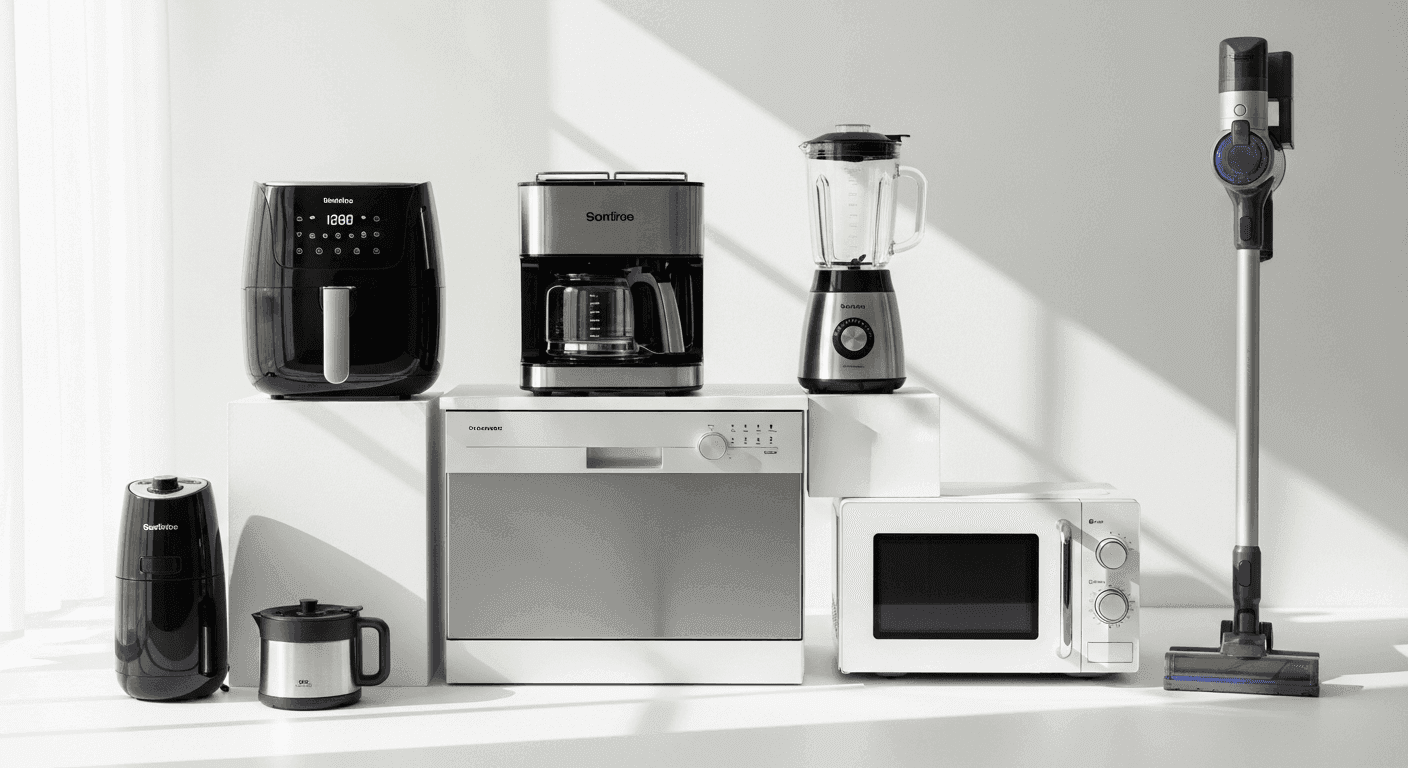
You're standing in your kitchen at 6 PM on a Tuesday, staring at a half-thawed chicken breast and wondering how you'll pull off dinner for four without losing your mind. Sound familiar? The right appliances turn that panic into actual possibility—they compress cooking time, expand what you can make, and genuinely change how your kitchen functions. The difference between a mediocre appliance and a great one isn't just about performance; it's about reliability, versatility, and whether it actually makes your life easier or just takes up counter space. Here's what separates the ones worth your money from the dust collectors.
The best home appliances for 2026 share three core qualities: they solve real problems (not invented ones), they're built to last beyond the warranty period, and they earn their spot on your counter by doing multiple things well. A great appliance integrates into your routine so seamlessly that you wonder how you ever lived without it. Whether you're a casual cook grabbing ingredients after work or someone who meal-preps on Sundays like it's a competitive sport, the right tools make the difference between dreading cooking and actually enjoying it.
Here's our roundup of six appliances that genuinely deserve your attention, broken down by what makes each one stand out and who should actually buy them.
1. Ninja Foodi DualZone Air Fryer
This thing is honestly impressive for families or anyone who meal-preps seriously. The dual-basket setup means you can roast broccoli at 400°F while crisping chicken wings at 380°F—and they finish at the exact same time thanks to the Smart Finish feature. It's not magic, but it feels like it when you're juggling multiple dishes. You get 8-10 quarts of total capacity split between two independent zones, so you're not limited to tiny portions either. The actual cooking quality is excellent; you get that golden, crispy exterior with less oil than traditional frying, which is the whole appeal of air frying in the first place.
The appeal here is real if your cooking life involves complexity. Multiple cookbooks and recipe websites are built around the assumption that you're cooking one thing at a time, which is frankly outdated. With the Foodi, you diversify without extending dinner prep by 30 minutes. Beyond air frying, you've got roasting, baking, dehydrating, and reheating modes, so it's actually versatile despite looking like a unitasker. Cleanup is genuinely painless—both baskets and crisper plates are dishwasher-safe, which matters more than you'd think when you're tired.
The real trade-off is space. This appliance is chunky and takes up serious real estate on your counter or in storage. Some models run loud at higher temperatures, which can be annoying if you have a small kitchen where the air fryer is three feet from your dinner table. If you're working with limited counter space or live somewhere small, you might want to pass.
Best for: Families of four or more, meal-prep enthusiasts, anyone cooking multiple components regularly.
2. Vitamix Ascent Series A3500
This is a premium blender for people who actually use their blender, not the ones who bought one on impulse and use it twice a year. The A3500 has a 2.2-peak horsepower motor that legitimately pulverizes anything you throw at it—nuts, frozen fruit, leafy greens, ice—into silky-smooth results. The SELF-DETECT™ technology recognizes your container size and adjusts the blend time and programs automatically, which eliminates guesswork. You get five preset programs (smoothies, hot soups, dips and spreads, frozen desserts, self-cleaning), but you've also got variable speed control and pulse if you want manual precision.
What makes this stand out is the combination of sheer power and smart features. The touchscreen looks modern, wipes clean easily, and the built-in wireless connectivity means Vitamix can push new programs to your blender through their app. The 64-ounce container is low-profile enough to fit under most cabinet overhangs, which is a detail most people don't think about until they can't close their cabinet. The self-cleaning function (you literally just blend water and dish soap) saves you from scrubbing dried smoothie residue out of hard-to-reach blade areas.
Here's the honest truth: it costs $500-$650, which is a commitment. High speeds get loud—this isn't a quiet appliance. And if you only make the occasional smoothie, you're paying for capability you won't use. The footprint is substantial, so it needs dedicated counter real estate. But if you're making daily smoothies, nut butters, hot soups, or anything requiring serious blending power, this investment pays dividends over years of reliable use.
Best for: Health enthusiasts, daily smoothie makers, anyone who wants to turn raw ingredients into professional-quality results.
3. KitchenAid Artisan Series 5-Quart Tilt-Head Stand Mixer
This mixer has been a kitchen staple for decades, and it's still the gold standard for home bakers. The 325-watt motor handles everything from whipping meringues (requiring finesse and air incorporation) to kneading dense whole-wheat doughs (requiring serious torque). The tilt-head design actually matters—you can tilt the head up to access the bowl easily, add ingredients mid-mix, or scrape the sides without unplugging the whole thing. It comes with three essential attachments: a flat beater for general mixing, a dough hook for bread work, and a wire whip for incorporation.
The real magic is the power hub. This isn't just a mixer; it's a platform for expansion. Vitamix made the blender versatile by being powerful; KitchenAid made the mixer versatile by making it expandable. Over 10 optional attachments exist—pasta rollers, food grinders, spiralizers, ravioli makers—all sold separately. If you like making pasta from scratch or grinding your own sausage, this becomes the command center of your kitchen. The all-metal construction means this mixer will outlive most kitchen appliances; many people inherit their parents' KitchenAid and use it for another 20 years.
The obvious downside is weight and bulk. This thing is heavy, and it's not exactly a sleek countertop piece if you prefer minimalism (though the range of colors helps). Attachments add extra costs if you want to expand functionality. And if you're only baking occasionally, you might be overbuying.
Best for: Frequent bakers, bread makers, anyone who wants a multi-purpose kitchen workhorse built to last decades.
4. Breville Barista Express Impress
This semi-automatic espresso machine bridges the gap between pushing a button and becoming a certified barista. The big innovation is the Impress Puck System—a fancy name for assisted dosing and tamping that takes the guesswork out of espresso preparation. The machine automatically calculates the dose of coffee based on your settings, and a guided tamping lever ensures you apply consistent pressure at a 7-degree angle (which matters more than it sounds for extraction quality). This eliminates the messy part of espresso making—over-packed portafilters spraying grounds everywhere, under-packed ones producing weak shots.
You get an integrated conical burr grinder with 25 grind settings, so you're not buying a separate grinder and cluttering your counter. The ThermoCoil heating system reaches temperature quickly and maintains it consistently, which is crucial for pulling good shots. The steam wand lets you manually froth milk for lattes and cappuccinos, so you're not completely removed from the craft—you're just guided through the technical parts. Everything you need to start making espresso arrives in the box, including a stainless steel portafilter and cleaning tools.
The price is steep—$700-$850—which makes it a serious kitchen investment. Manual milk steaming requires practice; you'll waste milk learning the technique. The ThermoCoil system switches to steam mode slower than some competitor models, which can be annoying if you're making multiple drinks. It's also slightly bulkier than the original Barista Express, though still reasonably compact.
Best for: Coffee enthusiasts who want café-quality espresso at home without needing a barista's education, morning coffee people who value consistency.
5. Instant Pot Duo Crisp Ultimate Lid
The Instant Pot does something genuinely useful: it consolidates multiple appliances (pressure cooker, slow cooker, air fryer, steamer, sous vide machine, yogurt maker, bread proofer, and more) into one footprint. The real innovation with the Ultimate Lid version is that you get one single lid—permanently attached—that handles all 13 cooking functions. You're not swapping lids like you were with earlier Duo Crisp models, which sounds like a small thing until you realize you're no longer storing bulky lids or fumbling with attachments at dinner prep time.
The actual cooking capabilities are legitimately diverse. You can pressure cook a pot roast in 30 minutes, crisp it in the air fryer setting, or slow-cook it all day—all in the same pot. The capacity (6.5-8 quarts) handles family-sized portions. The digital interface isn't confusing, and the safety features mean you don't have to white-knuckle the lid worried about pressure explosions. The inner pot and air fry basket are dishwasher-safe, so cleanup isn't a production.
The trade-offs are real. This appliance is heavy and takes up notable counter or cabinet space. If you're new to all 13 functions, there's a learning curve—you'll spend time figuring out which function does what. Some versions don't have a non-stick inner pot, which matters if you want to sauté without oil or sticky rice without scrubbing. But functionally, if you want a single appliance to replace three or four others, this delivers.
Best for: Space-conscious cooks, families wanting meal versatility without buying specialty appliances, anyone who wants to pressure cook and air fry without the counter clutter.
6. Dyson V15 Detect
This cordless stick vacuum is the premium choice, and the price reflects that—$650-$750 for a vacuum requires justification. The justification exists in the Fluffy Optic™ head, which illuminates microscopic dust on hard floors so you actually see what you're cleaning (spoiler: your "clean" floors are filthy). The piezo sensor counts and sizes dust particles in real-time, automatically adjusting suction power when it detects higher concentrations. Your LCD screen shows you exactly what's happening, giving you proof that you've actually cleaned, which sounds trivial until you realize most vacuums work invisibly.
The Hyperdymium™ motor delivers serious suction across carpets and hard floors. The fully-sealed filtration traps 99.99% of particles as small as 0.3 microns, expelling cleaner air—major benefit if anyone in your household has allergies. The battery runtime is strong enough for substantial cleaning sessions. It transforms into a handheld for cars, stairs, and upholstery, so you're getting versatility beyond floor cleaning. The anti-tangle motorbar cleaner head actually prevents hair from wrapping around the brush roll, which is a practical feature that solves an actual problem.
The primary downside is the price. This costs more than most vacuums, and while durability is excellent, you need to commit financially. Battery life varies depending on whether you use full power mode or eco mode. The dustbin is relatively small, so homes with pets require frequent emptying. And the top-heavy weight distribution can become uncomfortable during extended use on stairs or ceilings.
Best for: People with allergies, households with pets creating constant dust, anyone who wants visible proof of cleaning efficiency and isn't price-sensitive on vacuums.
How to Choose the Right Top Home Appliances 2026
Assess Your Cooking Style and Frequency
Before you buy anything, be brutally honest about how you actually cook. If you meal-prep on Sundays and cook weeknight dinners, you need different appliances than someone who orders takeout five nights a week. The KitchenAid mixer makes sense for frequent bakers; a casual baker should probably invest that $400 elsewhere. The Vitamix A3500 shines for people making daily smoothies or nut butters; if you blend twice a month, you're overspending. Look at what you currently cook, what you want to cook but don't because it's tedious, and what's actually realistic given your schedule. The appliance should solve friction in your routine, not create guilt about unused gadgets.
Measure Your Space Honestly
This isn't romantic. Most kitchen appliances are larger than they look in photos, and "it'll fit somewhere" is how you end up with a Foodi air fryer taking up an entire shelf in your pantry. Measure your counter space, measure your cabinet heights, check your electrical outlet situation. Some appliances need dedicated power and space (the stand mixer, the espresso machine, the Dyson charging dock). If you're in a small apartment or kitchen, multi-function appliances like the Instant Pot Duo make more sense than buying five single-purpose tools. Honest space assessment prevents buyer's remorse faster than anything else.
Consider Maintenance and Cleanup
Neglected appliances collect dust on counters. The ones you actually use are the ones that don't create friction in your routine. If hand-washing components is annoying, dishwasher-safe parts matter—this is why the Ninja Foodi's dishwasher-safe baskets are genuinely appealing. The Vitamix's self-cleaning function saves time compared to other blenders. The Instant Pot's removable dishwasher-safe inner pot and basket is convenient. Some appliances (like the Breville espresso machine) require regular cleaning and descaling to function properly; factor that into your decision. If maintenance feels like a chore, you won't do it consistently.
Evaluate Durability and Warranty
Cheap appliances break, cost money to replace, and create frustration. Premium appliances from established brands (Vitamix, KitchenAid, Dyson, Instant Pot) have track records of lasting years beyond the warranty period. Check what each brand offers in terms of warranty coverage and customer support. A 10-year lifespan on a $500 appliance is $50 per year; a 2-year lifespan on a $200 appliance is $100 per year. Look at longevity, not just upfront cost. Reviews from owners who've used the appliance for 3+ years are more valuable than fresh reviews.
Match Features to Your Actual Needs
The Instant Pot has 13 functions; you'll probably use five regularly. The KitchenAid can take optional attachments; you might never buy any. The Vitamix has preset programs; you might just use variable speed. Features sound impressive in marketing copy, but they only matter if you'll use them. If you want an espresso machine purely for espresso (not milk drinks), the Breville's manual steam wand is frustrating. If you never bake bread, the dough hook attachment on the KitchenAid is just extra weight. Identify the core function you need, check that it's executed well, and treat extra features as bonuses rather than reasons to buy.
Making Your Appliance Investment Count
If you're building a kitchen setup from scratch, the Instant Pot Duo Crisp Ultimate Lid and KitchenAid Artisan mixer give you the most versatility per dollar spent—around $650 combined for two appliances that handle pressure cooking, air frying, slow cooking, mixing, kneading, and expansion into pasta-making. They're not the fanciest options here, but they're genuine workhorses. If budget isn't a constraint and you want the single best appliance in each category, the Vitamix A3500 is unmatched for blending power and intelligence, and the Dyson V15 Detect is the cleaning solution that actually delivers on claims.
The actual decision comes down to what friction exists in your current kitchen routine and what budget you're comfortable committing. Buy the appliance that solves a real problem, skip the one that sounds impressive on paper but won't fit your life, and remember that the best appliance is the one you actually use—measure your space, be honest about your cooking habits, and choose accordingly.