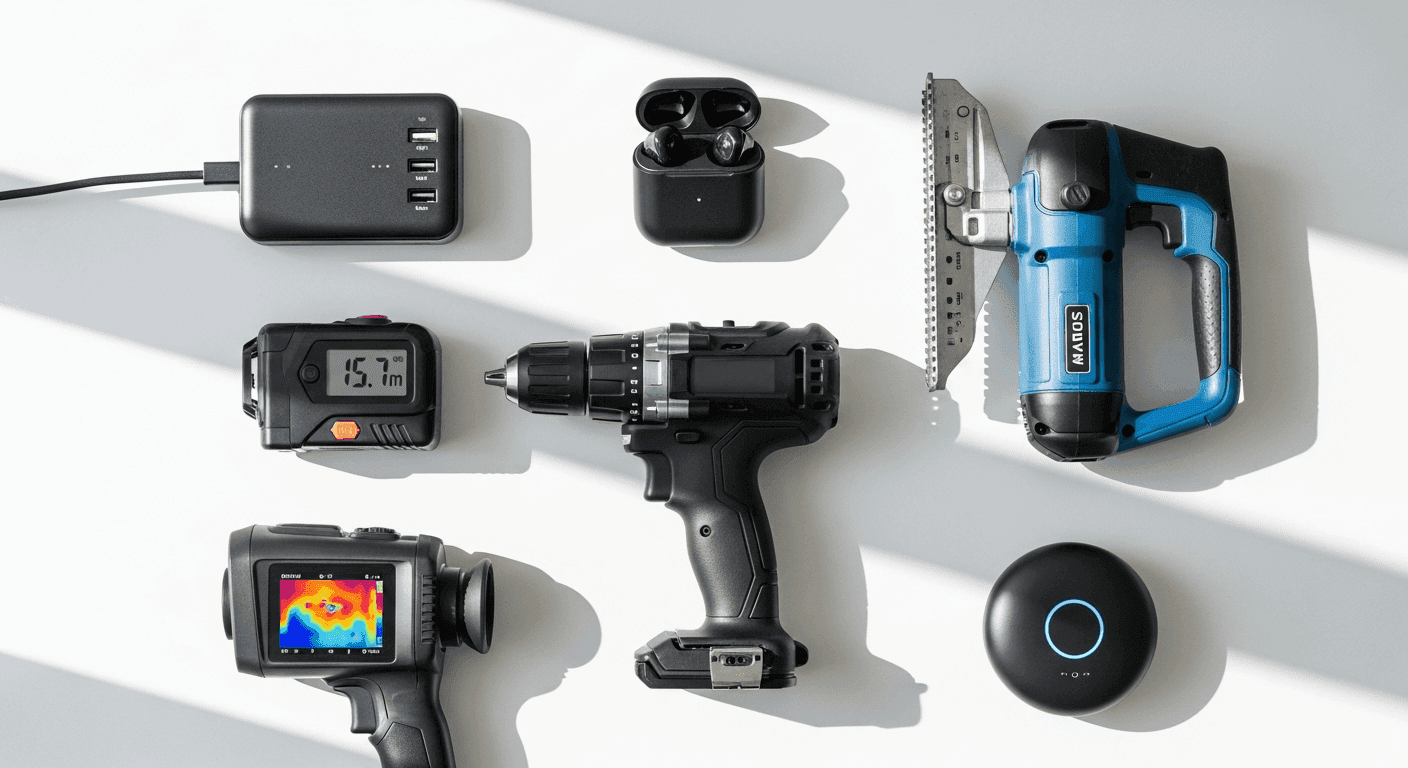
You know that moment when you're staring at your flat tire at midnight, or you're trying to drill into concrete with a tool that sounds like it's auditioning for a horror film? Yeah, that's when you realize your toolkit is holding you back. The difference between being able to tackle projects and actually enjoying them often comes down to one thing: having the right power tools and equipment that don't fight you every step of the way.
What separates genuinely great tools from the mediocre ones isn't just power—though that matters—it's the combination of thoughtful engineering, reliability you can actually count on, and features that solve real problems instead of creating new ones. A tool that's overpowered but exhausting to use is useless. One that's lightweight but cuts corners on durability is worse than useless. The sweet spot is where power meets practicality, where design reflects what actual users need.
Here's what we're covering: two professional-grade drill essentials, a smart thermostat that's doing way more than turning your heat on and off, a solar-powered security camera that actually means what it says about "wireless," a laser measure that makes tape measures feel ancient, smart lighting that started the whole ecosystem craze, and a portable air compressor that won't leave you stranded.
1. Milwaukee M18 2904 Hammer Drill
This isn't just another cordless drill—it's the drill that makes you wonder why you ever settled for something else. At 3.3 pounds and less than seven inches long, the M18 2904 punches way above its weight class with 1,400 inch-pounds of torque that handles masonry, steel, and general framing without breaking a sweat. The brushless motor means you're not fighting friction and heat loss; you're getting actual efficiency and tool longevity instead of replacing it in two years.
What makes this genuinely special is the engineering philosophy behind it. Milwaukee crammed professional-level performance into a form factor that doesn't make your arm hate you after an hour. Contractors grab this because it works in tight spaces—above your head, deep in cabinets, or in cramped corners where a full-size drill becomes a wrestling match. The power-to-weight ratio here actually outperforms some 24-volt competitors, which is the kind of detail that separates "good tool" from "tool that makes you better at your job."
The real trade-off? The sticker shock. This isn't a casual purchase, and if you're hanging a few shelves a year, you're absolutely overspending. Also, Milwaukee sells the battery and charger separately on bare tool configurations, so budget accordingly. But if you're planning to build a kit around the M18 ecosystem—which you should, because it's genuinely robust—that separation actually works in your favor.
Best for: Contractors, serious DIYers planning multiple projects, and anyone doing structural work or drilling into tough materials regularly.
2. Milwaukee M18 Fuel 2953-20 Impact Driver
If the hammer drill is a boxer, the impact driver is a surgeon with a hammer. The 2953-20 does something that looks like physics cheating: it drives three-inch lag bolts into stacked lumber in two seconds flat. That's not marketing copy; that's what happens when you combine high torque with precision speed control. The multiple speed settings mean you're not gambling with every fastening task—you can dial in exactly what you need.
This tool changed how people think about fastening. Where a regular drill driver would strip screws or leave you muscling a bolt that doesn't want to go, this impact driver just... handles it. The brushless motor runs at peak efficiency and doesn't peter out under load like older designs. In testing, boring a full-inch spade bit through pressure-treated 2x6 lumber took under three seconds. That's the kind of speed that adds up across a full project—we're talking hours saved, not minutes.
The downside is real, though. This level of performance costs real money, and the batteries and charger are almost never included. For delicate trim work or fastening anything where control matters more than speed, the sheer torque can work against you if you're not experienced. This is a specialist tool that happens to be incredibly good at its specialty.
Best for: Professional contractors, heavy-duty DIYers doing framing or structural work, anyone who values speed and reliability enough to invest in quality.
3. Ecobee Smart Thermostat Premium
This is a thermostat that got bored with just being a thermostat and decided to handle your home's entire environmental personality. Beyond controlling heat and cooling, you get a built-in voice assistant, an air quality monitor, and home security functionality all in one elegant box. The real intelligence is in those remote room sensors—they detect which rooms are occupied and adjust your heating or cooling to focus on people instead of warming empty guest bedrooms.
The energy reporting is where this becomes genuinely useful, not just clever. You can actually see where your heating and cooling dollars are going, spot inefficiencies, and make changes that matter. The seamless integration with major smart home platforms means this becomes your climate control hub, talking to your lights and security system and doing the thinking so you don't have to. It's the kind of tool that justifies itself through convenience: remote control, scheduling, automation—all from an intuitive app.
Here's what'll slow you down: most homes need a C-wire for proper installation, and retrofitting that can mean electrician bills you didn't budget for. The advanced features have a learning curve, and some people find the voice assistant functionality adds complexity they didn't ask for. But if your home already has the wiring or you're in a new enough building, this is overkill in exactly the right way.
Best for: Homeowners serious about energy efficiency, anyone already invested in smart home automation, people who want their thermostat to actually think instead of just respond.
4. Eufy SoloCam S340 Wireless Outdoor Security Camera
A truly wireless outdoor security camera sounds like a promise companies make and never quite deliver. The S340 actually delivers it: a solar panel that continuously trickles power back into the battery means you're not managing a charging schedule. The 4K dual-lens setup gives you sharp, detailed video that doesn't leave you squinting at grainy footage trying to identify what happened. Mechanical pan and tilt lets you remotely adjust where you're looking, and the color night vision means you're not watching green thermal nonsense—you're seeing actual details in darkness.
What really matters here is the economics: you avoid subscription fees because local storage is built in. No cloud storage tax, no monthly creep of charges. The integrated spotlight actually deters people; that motion-activated illumination works. The voice control integration means you can check in from your phone or ask your smart assistant what's happening outside without fumbling with apps.
The catch is solar charging isn't magic—it depends on your roof orientation and climate. A north-facing wall in a cloudy region means you'll still be managing the battery. The storage is finite, so you can't record forever locally. And you might need a separate hub to unlock the full local storage potential, which adds cost you didn't expect. But if you've got decent sun exposure and you hate subscription services, this solves a real problem elegantly.
Best for: Homeowners with good solar exposure, anyone tired of monthly camera subscription fees, people who want genuine wireless operation without compromise.
5. Leica DISTO D2 Laser Measure
A laser measure sounds like overkill until you've used one and suddenly realize how much time you've wasted with tape measures, ladders, and squinted eyeballing. The D2 reads distances up to 330 feet with accuracy that's genuinely within 1/16 inch, and that matters for material estimation and verification. The intelligent end-piece automatically compensates for measurements from edges or corners—it sounds minor until you realize it eliminates the single biggest source of human error in measuring.
The Bluetooth connectivity to the DISTO Plan App opens up capabilities tape measures laugh at: calculating irregular room areas, creating digital staking points for construction layouts, storing measurements so you're not writing them on your hand. It's fast—you point, click, and you have a number—which compounds into serious time savings across a full project. Contractors and architects use these because the economics work out: accurate measurements at speed beats the old method in every way that matters.
The limitation is real, though. Direct sunlight murders the range and accuracy; cloudy days and indoor work are where this shines. The extended features require app usage and Bluetooth pairing, which adds a technical layer some people don't enjoy. And yes, it's expensive compared to a $15 tape measure, but comparing them is like comparing a smartphone to a pocket calculator.
Best for: Contractors, architects, serious DIYers doing material estimation, anyone doing renovations where accuracy directly affects cost.
6. Philips Hue White and Color Ambiance Starter Kit
This starter kit is the reason people say "smart lighting ecosystem" instead of just "smart bulbs." Sixteen million colors and tunable white light means you're not choosing between "warm" and "cold"—you're choosing the specific ambiance you want at 11 PM versus 7 AM. The three included bulbs and the Hue Bridge hub mean you're getting the actual foundation of a system, not a tease of what's possible.
The reliability here is genuinely exceptional. Hue bulbs just work, reliably, across Amazon Alexa, Google Home, and Apple HomeKit without the fragile workarounds other systems require. The 800 lumens per bulb is legitimate brightness, not "well it's technically illuminated." The Hue app is intuitive enough that automation routines feel like shortcuts instead of programming. Building a lighting system around this foundation means future expansions actually work—you're not discovering incompatibilities six months in.
The investment stings, especially if you're comparing individual Hue bulbs to generic smart bulbs. You need the bridge for the ecosystem to function properly, which adds to the upfront cost. If you're renting or likely to move, this feels expensive for something you'll cart with you. But if you're settling in and you want lighting that actually gets smarter over time, this ecosystem pays dividends.
Best for: Homeowners planning long-term smart home integration, anyone who wants lighting automation that actually works reliably, people willing to invest upfront for a stable platform.
7. Viair 88P Portable Air Compressor
This compressor exists because someone got tired of watching inflators plug into cigarette lighters and then perform like asthmatic turtles. The 88P connects directly to your vehicle's battery via heavy-duty clamps, bypassing the amperage limitations that cripple lesser inflators. That means the permanent magnet motor gets the power it needs, and you actually get consistent, fast inflation instead of a 20-minute ordeal that overheats your device.
Real-world performance: a standard sedan tire from flat to 30 PSI in under three minutes. Thirty-three-inch SUV tires without triggering thermal overload. The gearless motor design means less friction and less heat buildup, which translates to reliability when you actually need it—3 AM on a dark highway, not as a once-a-year test. The accessory kit is genuinely comprehensive: LED flashlight for night visibility, Presta valve adapter for bicycles, multiple tips for different inflatables, and 16 feet of hose plus a 10-foot cord that actually reaches your valve stems. Everything fits in a carrying case that doesn't feel like you're storing a toolbox.
The requirement to connect directly to the battery means you need alligator clamps, which is slightly less convenient than a 12V socket but massively more reliable. It's not a continuous air tool compressor—it's designed for tire inflation, not powering nail guns all day. And yes, it costs more than the absolute cheapest inflators, but you're paying for something that actually works when your tire is halfway flat at an inconvenient time.
Best for: Vehicle owners, roadside emergency preparedness, anyone who's been frustrated by inadequate inflators and values reliability over convenience.
How to Choose the Right Best Power Tools
Match Power to Your Actual Tasks
Here's where people go wrong: they either buy a lightweight toy that can't handle the job, or they overspend on industrial-grade equipment for occasional use. A hammer drill like the Milwaukee makes sense if you're doing structural work, drilling into masonry regularly, or hanging heavy things. If you're assembly work and occasional drywall hanging, you're paying for capability you'll never use. Think about the toughest material you'll actually drill through and the frequency you'll be doing it. Once a year versus twice a week is the difference between renting and owning.
Battery Ecosystem Matters More Than You Think
Buying one Milwaukee tool means you're committing to the M18 platform, which actually works in your favor. One set of batteries runs multiple tools. You're not maintaining three different charging systems. This is why contractors standardize on one brand—it's not loyalty, it's economics. Before buying that drill, check what batteries you'll need, what they cost, and whether the ecosystem has other tools you anticipate needing. A $50 battery purchase becomes expensive when you need it for a second tool.
Wireless Doesn't Mean "No Maintenance"
Security cameras with solar panels, thermostats that integrate smart home platforms, wireless compressors—they all need something. Solar charging depends on sunlight exposure. Smart thermostats need the right wiring. The compressor needs battery connection reliability. Wireless is about convenience, not zero-maintenance. When you're evaluating whether a tool's wireless feature actually solves your problem, be honest about your specific situation. A north-facing wall might not get enough sun for a solar camera. Some older homes might lack C-wires for thermostat installation.
Accuracy and Speed Compound Over Projects
The laser measure doesn't look valuable for a one-time job, but across a year of projects, the measurement speed and accuracy saves hours. The impact driver shaves minutes off fastening that add up. The security camera's local storage saves you subscription fees that accumulate. These tools justify themselves through accumulated benefit, not single-use heroics. If you're planning projects regularly, tools that improve workflow speed and accuracy genuinely pay for themselves.
Investment-Grade Tools Worth the Premium
The Milwaukee impact driver and hammer drill represent different aspects of tool quality: one prioritizes pure speed and fastening power, the other balances compact design with serious drilling capability. Both use the same brushless motor technology and M18 battery ecosystem, meaning you're investing in a platform, not isolated tools. If you're doing structural work or fastening anything demanding, the impact driver alone justifies itself through time saved. If you're drilling into tough materials in tight spaces, the hammer drill's engineering shines. Together, they form the foundation of a reliable toolkit that doesn't compromise on performance.
The Leica laser measure, Viair compressor, and Eufy camera represent smarter approaches to old problems. Laser measuring beats tape measures on speed and accuracy. Direct battery connection beats questionable 12V sockets on reliability. Solar charging beats subscription fees on lifetime cost. These aren't luxury upgrades—they're tools that solve real frustrations with elegant design.
Start with the two Milwaukee tools and the laser measure if you're planning active projects, or focus on the compressor and camera if you prioritize reliability and convenience in daily maintenance. Pick the tools that solve your actual problems, not the ones that sound impressive.