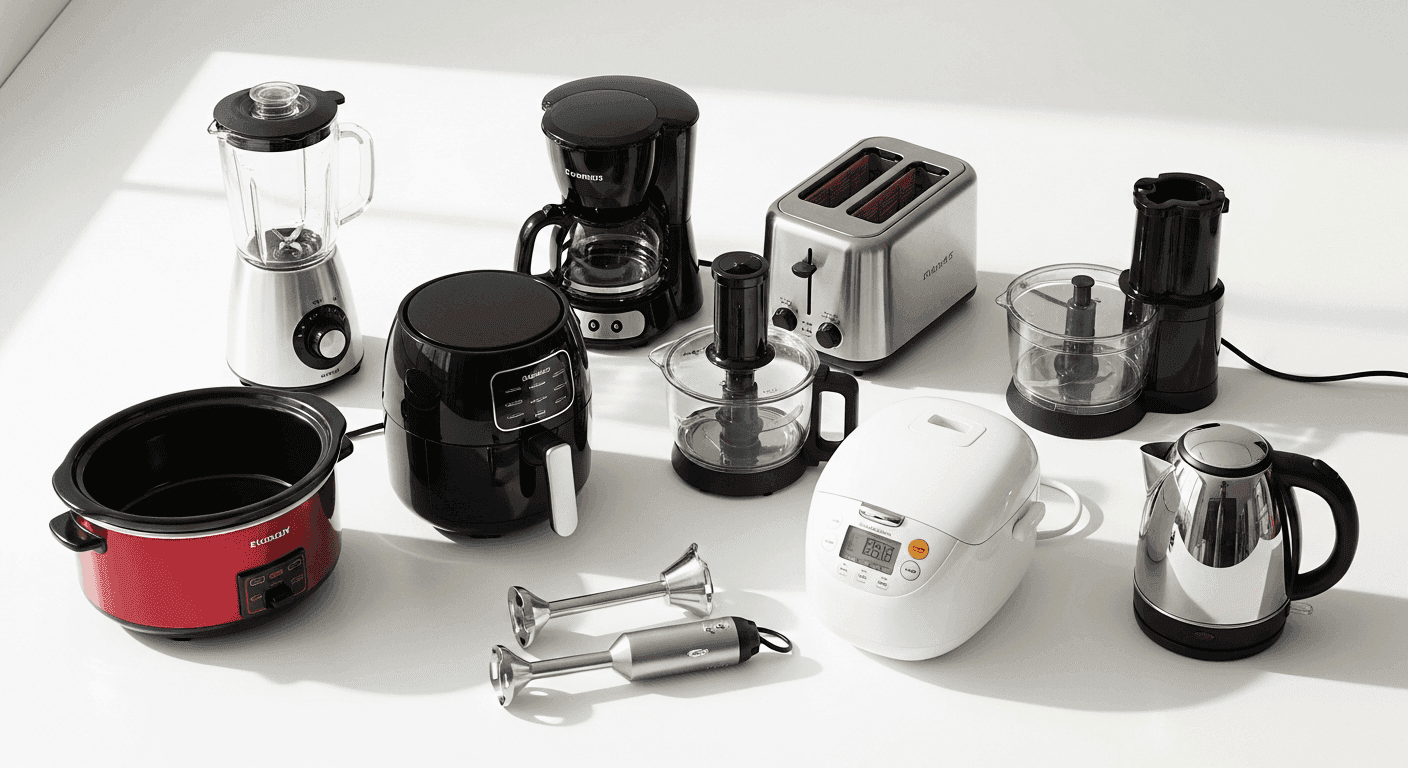
You've stared at your kitchen counter for the hundredth time this week, wondering if you're actually using all those appliances or just collecting dust catchers. Here's the thing: most people buy small kitchen appliances based on a single Instagram video or a friend's recommendation, then wonder why they're gathering clutter within six months. The difference between an appliance you'll actually use daily and one destined for the back of a cabinet comes down to thoughtful matching—does this tool fit your lifestyle, or are you forcing yourself into someone else's cooking habits?
What separates genuinely useful kitchen appliances from the noise is practicality meeting design. A flashy blender means nothing if it's too loud for your small apartment. A precision coffee maker won't impress if you're rushing out the door every morning. The best appliances solve real problems in your actual kitchen, not hypothetical ones. They're built to last, intuitive enough that you won't need to consult the manual for basic tasks, and honest about their trade-offs—like whether that compact size is worth a smaller capacity.
This guide covers nine genuinely useful small kitchen appliances across different cooking and cleaning needs, breaking down what actually makes each one worth counter space.
1. Fellow Aiden Precision Coffee Maker
If you're the type of person who reads about coffee extraction ratios for fun, the Fellow Aiden is designed for your brain. This is a coffee maker that lets you control water temperature, pulse timing, and brew profiles—basically treating your kitchen like a mini coffee lab. It switches between pour-over and batch brewing, handles up to 10 cups, and has this slick angular design that actually looks intentional on your counter instead of like an appliance you regret.
The real party trick is the Brew Profiles feature: you upload recipes directly to the machine and it executes them consistently. Schedule it the night before, and your perfectly dialed-in coffee is ready when you wake up. That's either brilliant or unnecessary depending on your morning personality. The interactive LED screen makes adjustments straightforward—no hunting through menus like some other premium brewers.
Here's the trade-off: at $499, you're paying roughly three times what a solid automatic drip costs. If you're brewing the same coffee every single day without tweaking variables, you're spending money on precision you won't use. The Aiden shines for people who actually enjoy the process of dialing in coffee or want absolute consistency across multiple brew styles. Best for: Coffee enthusiasts who genuinely care about extraction variables and want the flexibility to experiment without buying separate equipment.
2. Breville Barista Express Impress
The Breville Barista Express Impress bridges a gap that usually doesn't exist: it's legitimately beginner-friendly without dumbing down the actual espresso-making process. You get a built-in conical burr grinder, an assisted tamping system that handles one of the most intimidating steps, and real 9-bar extraction pressure that pulls shots actual espresso snobs would approve of.
What makes this different from cheaper espresso machines is the intelligent dosing system—it calculates the right amount of grounds automatically, then the assisted tamping takes the guesswork out of pressure application. The steam wand creates proper microfoam for lattes and cappuccinos, not just hot milk with bubbles. The buttons are clearly labeled and the interface doesn't require a PhD in Italian engineering.
The catch: this is still a workflow. You're grinding, tamping, extracting, and steaming multiple components of your drink. If you want coffee in 30 seconds, espresso isn't your thing. Some users report occasional underextraction when the machine's dosing gets it slightly wrong, and the volume buttons require manual stopping for consistency rather than auto-shutoff. At $800-$849, it's positioned as "prosumer" equipment, sitting between the entry-level machines and the $2000+ territory. Best for: People who want café-quality espresso at home and actually enjoy the ritual of pulling shots without needing to become a certified barista first.
3. Vitamix 5200 Blender
The Vitamix 5200 is what happens when you stop making compromises. This blender has actual industrial-grade power—it pulverizes fibrous vegetables, nuts, and frozen fruit with the kind of muscle that makes other blenders look like they're playing at the job. The 64-ounce container handles serious batches, the variable speed control lets you fine-tune anything from a coarse chop to silky smoothness, and the high-performance blades generate enough friction to heat soup from cold ingredients in minutes.
This is a blender that respects what you ask it to do. Need creamy almond butter? Done in under two minutes. Green smoothie for four people? No problem. The self-cleaning function (just water and detergent, blend on high) is genuinely useful, and the thing is built like it'll outlive your kitchen renovation plans. People still use Vitamix 5200s they bought 15 years ago.
The downsides are real though: at $400-$550, it's an investment. The 64-ounce tall design doesn't fit under some kitchen cabinets—measure your space first. And it's loud. If you have neighbors or an infant who naps at 7 AM, you'll hear from them. The power also means you can't zone out while it's running; it actually requires attention. Best for: Serious cooks who blend regularly, meal-prep enthusiasts, or anyone with a household that actually consumes smoothies, soups, and nut butters consistently.
4. KitchenAid Artisan Series 5-Quart Tilt-Head Stand Mixer
The KitchenAid Artisan is the appliance equivalent of a reliable friend who's been in your life so long you forget what you'd do without them. The 5-quart stainless steel bowl handles everything from meringues to bread dough, the tilt-head design means you can actually access what you're mixing without unscrewing the whole unit, and the included flat beater, wire whip, and dough hook cover the fundamentals.
But here's why it's actually worth the space: the power hub accessory system. Over 10 optional attachments exist—meat grinders, pasta makers, spiralizers, food grinders—so one appliance replaces several others. The all-metal construction means it's designed to last generations, not just the warranty period. The aesthetic is iconic enough that it's genuinely nice-looking on the counter, so it doesn't need to hide in a cabinet.
The real trade-off is size and counter commitment. This isn't a compact appliance—it's a permanent fixture that needs real estate. At $350-$500, it's not cheap, though not outrageous for what it does. If you're a casual baker who makes cookies three times a year, you're overspending on capability. If you bake weekly or want multiple food-preparation functions in one tool, it becomes sensible. Best for: Bakers and home cooks who actually use a stand mixer regularly and want the flexibility of add-on attachments without buying separate single-function tools.
5. Roborock Saros 10R Robot Vacuum and Mop
The Roborock Saros 10R is legitimately impressive at one specific thing: operating unsupervised in a space and actually cleaning it without requiring you to pre-tidy like you're expecting guests. The StarSight Autonomous System 2.0 navigation eliminates the usual bulky LiDAR turret, giving it a slim 3.14-inch profile that slides under furniture most other robots can't reach. The obstacle recognition actually works—it avoids cables and pet toys instead of getting tangled, which means you're not babysitting it constantly.
The mopping function is the genuine standout. Unlike budget robot mops that just push water around, this one actually lifts dried stains through active scrubbing. On hard floors, this combination of vacuuming and mopping means you're genuinely reducing cleaning tasks. The whole premise is that you set it to run while you're at work or asleep, and actual cleaning happens without your involvement.
Here's the honest part: at $800-$1200, you're spending serious money. It's excellent on hard floors but struggles with thick carpets the way most robot vacuums do. Battery life limits coverage in very large homes, and the dustbin is smaller than traditional uprights, so you're emptying it more frequently. If your home is mostly hard floors, this is a legitimate solution. If you have deep carpets and expect one machine to handle everything, you'll be disappointed. Best for: Hard-floor homes where you want truly hands-off cleaning and actively lifted mop stains matter more than deep carpet cleaning.
6. Ninja Double Stack XL SL400UK Air Fryer
The Ninja Double Stack XL is basically saying "what if you could air fry two completely different things at once?" The dual-basket design with stackable trays means you're not stuck choosing between frozen fries and salmon for dinner—you cook both simultaneously at different temperatures if needed. The XL capacity is genuinely useful for families or anyone who meal preps because you can crank out substantial quantities without running the machine three times.
Beyond air frying, it handles roasting, reheating, dehydrating, and baking, so it's not a one-trick appliance. The efficient air circulation actually delivers crispy results consistently, which matters more than you'd think—cheap air fryers produce mediocre textures. The dual-basket flexibility is the real value proposition, especially if cooking for more than two people regularly.
The con is unavoidable: this appliance is bulky. It needs real counter space and it's heavy enough that "put it in the cabinet" becomes annoying. At $300-$350 (USD equivalent), you're paying a premium versus single-basket models, though the capacity difference justifies it for some households. If you live alone or cook for two people, the bulk isn't worth it. If you're feeding four or more regularly, the time savings probably are. Best for: Families or meal-prep enthusiasts who want to air fry multiple items simultaneously without staggering cooking times.
7. Technivorm Moccamaster KBGV Select Coffee Brewer
The Technivorm Moccamaster is what happens when a Dutch coffee company spends decades perfecting automatic drip coffee and refuses to add unnecessary features. It maintains water temperature between 196°F-205°F (the actual sweet spot for extraction), the hot plate keeps coffee warm without scorching it, and there's a switch to brew full or half batches depending on whether you're making coffee for one or four.
This is handcrafted in the Netherlands with high-quality materials, and it's genuinely built to last 20+ years. The auto-stop feature prevents dripping when you remove the carafe, which is a small detail that matters when you're rushing. The entire philosophy is: do one thing excellently and don't overcomplicate it. Pour water, press a button, wait.
At $490, you're paying roughly the same as the Fellow Aiden, but the value proposition is different. The Moccamaster offers zero control—you can't adjust temperature or timing. It just consistently brews exceptional coffee because it was engineered by people who think about water temperature obsessively. If you want precision control, buy the Fellow. If you want to stop thinking about coffee variables and just drink excellent coffee daily, this is it. The classic design also doesn't suit everyone's aesthetic—it reads traditional, not modern. Best for: People who want genuinely excellent automatic drip coffee without complexity, and who trust that someone else's engineering is better than their own tweaking instincts.
8. Dyson V15 Detect Cordless Vacuum
The Dyson V15 Detect is expensive cordless vacuuming, but it's expensive for reasons that actually matter. The laser illumination reveals microscopic dust on hard floors that's invisible to your eye—genuinely useful if you care about allergen levels. The surface detection system intelligently adjusts suction power based on floor type, optimizing battery life so you're not draining the battery on hard floors where you don't need maximum power.
The integrated air quality sensor measures and displays particle size and quantity, giving you actual feedback on your home's cleanliness. The cordless design means maneuverability that corded vacuums can't match, and the debris pickup performance is legitimately excellent across carpet and hard floors. This isn't a compromise machine—it's a premium cordless vacuum that actually performs.
The realistic trade-offs: at $600-$800, it's premium-priced. Battery life becomes limiting in very large homes—you might need a second charge for a 3000+ square foot space. The dustbin capacity is smaller than traditional uprights, so frequent emptying is required. If you have minimal carpeting and mostly hard floors with pet hair and dust, this is genuinely impressive. If you need to vacuum a 5000 square foot house with dense carpeting, a corded upright might be more practical. Best for: Hard-floor homes with some carpet where cordless convenience and intelligent features justify premium pricing, and whose owners care about actually seeing dust levels.
9. Cosori TurboBlaze Air Fryer
The Cosori TurboBlaze is the air fryer that proves you don't need to spend $300+ or buy a dual-basket monster to get consistently excellent results. The 6.3-quart single basket capacity serves about four people comfortably, the touchscreen interface is intuitive without being overcomplicated, and the five fan speeds plus wide temperature range give you actual flexibility for different recipes.
What matters is the execution: this air fryer delivers crispy, evenly cooked results consistently, often outperforming more expensive competitors. The TurboBlaze air circulation technology isn't marketing—it actually crisps things efficiently. At $130-$180, you're getting performance typically found in machines twice the price. The sleek design doesn't look like an appliance you immediately regret buying.
The limitation is honest: you can only cook one thing at a time, unlike dual-basket models. For two people or single-person households, that's fine. For a family of five, the single basket becomes a bottleneck. It's not as large capacity as oven-style air fryers, so batch cooking takes multiple runs. But at this price point, those trade-offs are genuinely reasonable. Best for: Singles, couples, or small families who want reliable air frying performance without the bulk, space commitment, or expense of larger models.
How to Choose the Right Small Kitchen Appliances
Match the Appliance to Your Actual Behavior
The most important step is ruthlessly honest self-assessment. Do you actually enjoy making coffee, or do you just need caffeine quickly? Do you bake weekly, or did you promise yourself you'd start baking and never follow through? Do you have counter space, or are you pretending you do? Buy an appliance designed for how you actually live, not how you aspire to live. The best premium coffee maker is waste if you're rushing out the door. The most versatile stand mixer is clutter if you bake twice a year. Spend five minutes imagining a typical week and picture the appliance's role in it—if you can't place it naturally, skip it.
Calculate True Cost Per Use
A $500 appliance is expensive until you realize you'll use it four times per week for five years, which is roughly 1000 uses at $0.50 each. That premium blender becomes cost-effective. A $300 specialty gadget you'll use twice? That's $150 per use. Look at price against realistic usage frequency, and don't let "potential" justify spending. An air fryer only makes sense if you'll actually cook in it regularly—not if it'll sit on the counter as optimistic decor.
Space Reality Check
Measure your counter space, measure under your cabinets, and measure your cabinet depth if you're planning to store things. The Vitamix 5200 and KitchenAid Artisan are significant commitments that don't fit everywhere. The Ninja dual-basket air fryer is not compact. Be specific: if an appliance doesn't fit in your intended space, it doesn't exist for you—it'll become obstacle or storage nightmare. Factor storage space, not just counter space, into the calculation.
Build Quality vs. Novelty
New features sound impressive in product descriptions but mean nothing if the appliance falls apart in two years. Prioritize build materials (all-metal construction beats plastic), warranty length (better companies stand behind their products), and brand track record (people keep using 15-year-old Vitamix blenders for a reason). Read actual user reviews from people who've owned the appliance for 3+ years, not reviews from people excited about their new purchase. Avoid appliances that seem to be primarily marketed on gimmicks or trendy features. Durability beats novelty every single time.
Where Your Kitchen Stands
If you're building a serious home coffee setup, pick one coffee maker based on whether you want precision control (Fellow Aiden) or reliable consistency (Technivorm Moccamaster). If espresso appeals to you, the Breville Barista Express Impress is genuinely the best entry point that doesn't patronize beginners. For blending and food preparation, the Vitamix 5200 and KitchenAid Artisan are the only two appliances in this list truly worth counter space because they're built to last and actually earn their cost through years of use.
For cleaning, choose based on your actual flooring: hard-floor homes benefit from the Roborock Saros 10R's mopping capability, while the Dyson V15 Detect is premium cordless vacuuming for mixed flooring. Air fryer choice depends on household size—single-basket Cosori TurboBlaze for small households, dual-basket Ninja for families who cook regularly.
Start by identifying one genuine problem in your kitchen routine, find the appliance designed to solve that problem, then actually commit to using it instead of abandoning it after three weeks.