Over 70% of families wish they'd recorded their relatives' stories before it was too late. Yet most people never start because they're intimidated by the blank page, overwhelmed by the logistics, or simply don't have the time to sit down and write. The barrier isn't desire—it's execution.
Memorygram Legacy Book has fundamentally changed how families preserve their histories by removing the biggest obstacle: the writing requirement. Instead of forcing storytellers into a traditional memoir format, this guided platform meets people where they are—whether that's speaking into a phone, answering weekly prompts, or chatting during a scheduled interview. The process feels natural because it honors how people naturally share stories: through conversation.
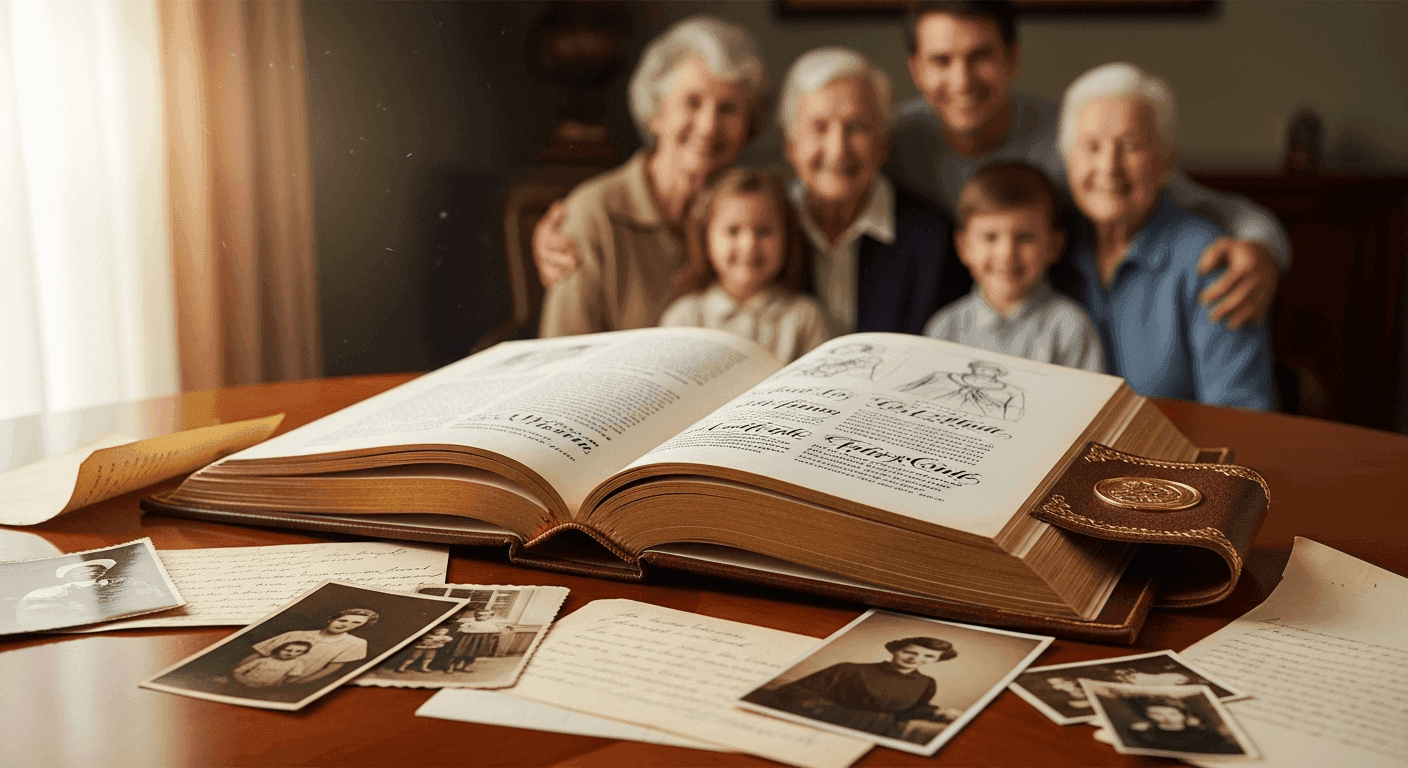
The result is a stunning, full-color hardcover book that feels like a family heirloom, complete with voice recordings embedded through QR codes that let future generations actually hear their ancestors' voices. Discover how to transform family stories into a lasting legacy with Memorygram today.
Why Voice Recording Beats Written Memoirs for Capturing Authentic Family Stories
Personality shines through speech
Tone, humor, and cadence reveal who someone really is in ways typed words often miss. A grandfather's chuckle, a grandmother's particular way of emphasizing certain words, the warmth in someone's voice when they talk about the people they love—these elements vanish in traditional text-based memoirs. Voice captures the essence of a person, not just their history.
Eliminates writer's block
Speaking feels natural; writing triggers perfectionism and analysis paralysis. Most people can ramble comfortably for 30 minutes about their lives without overthinking every sentence. The moment they sit down with a blank page, the internal editor takes over. Memorygram removes that friction by inviting storytellers to simply talk.
Accessibility for non-writers
People who've never journaled or written formally can still create rich, detailed narratives. A lifetime of experiences doesn't require perfect grammar or literary skill to matter. Voice recording democratizes legacy-building, making it possible for anyone to participate, regardless of their comfort with writing.
Faster memory recall
Conversational flow helps storytellers remember details they'd forget staring at a blank screen. Questions trigger memories in a natural sequence. One story leads to another. The momentum of speaking keeps the memories flowing in ways that a questionnaire simply cannot replicate.
Generational appeal
Younger family members connect with hearing a grandparent's actual voice in the finished book. Children who never met a relative can still experience their personality through audio. This creates an emotional bridge across generations that no written description can match.
Reduces time commitment
Speaking a 30-minute story takes less effort than writing 10,000 words. Busy families can participate without adding another project to an already full plate. A single phone call can capture what might take weeks to write.
Preserves speech patterns
Accents, expressions, and unique ways of speaking become part of the family legacy. These linguistic fingerprints make each person unforgettable. They're the details that bring someone back to life when you hear them years later.
How Memorygram's Phone Interview Feature Works for Seniors and Non-Tech Users
Memorygram calls you
No need to navigate apps or websites; the platform schedules a time and initiates the conversation. This is the feature that changes everything for older family members. There's no learning curve, no passwords to remember, no confusion about which button to press. Memorygram simply calls at an agreed-upon time.
Professional transcription included
Every word is captured accurately and converted into written text for the book. Families don't need to hire expensive transcribers or manually type out recordings. The service handles the entire process, delivering polished text within days.
Perfect for limited internet access
Ideal for family members in rural areas or those without reliable WiFi. A phone connection is all that's needed. This opens up legacy-building to relatives who might otherwise be excluded due to technology barriers.
Comfortable conversation format
Feels like chatting with a friend rather than doing an interview. The trained interviewers guide the conversation naturally, asking thoughtful questions that spark memory without making anyone feel interrogated or put on the spot.
Flexible scheduling
Calls can be arranged around health appointments, family visits, or energy levels. There's no rigid timeline. If someone isn't feeling well on a scheduled day, the interview simply moves to another time.
No technical skills required
Participants simply answer questions—Memorygram handles all the recording and logistics. This removes every excuse someone might use to avoid participating. It's genuinely as simple as answering the phone.
Multi-session options
Longer stories can be captured across several phone calls without overwhelming the storyteller. A person doesn't need to compress their entire life story into a single conversation. Multiple sessions allow for depth and reflection.
Recorded for posterity
The actual phone conversation can be referenced if clarification is needed later. Nothing gets lost. Everything is preserved in case details need to be revisited during the editing process.
From Spoken Words to Heirloom Pages: The Memorygram Creation Process
Weekly email or audio prompts
Structured questions arrive regularly to spark memory recall and reflection. These prompts function as a personal interview coach, guiding storytellers through different chapters of their lives systematically. Each prompt is designed to trigger memories and encourage deeper reflection.
Choose your storytelling method
Speak into the app, write responses, or opt for phone interviews. Flexibility is built into every stage. Some people might answer written prompts while others prefer speaking. The method doesn't matter—the story does.
Audio transcription service
Spoken stories are professionally converted to text within days. Quality matters here. Professional transcribers ensure accuracy and preserve the conversational tone while making the content suitable for a printed book.
Organize and arrange chapters
Users can sequence stories thematically, chronologically, or by family member. The raw material gets shaped into a coherent narrative structure. What began as scattered conversations becomes a flowing family history.
Customize the physical book
Select cover designs, fonts, paper quality, and layout styles. Personal touches transform the book from a generic product into something that feels uniquely suited to the family. Every choice reflects the personality of the person being honored.
Add photos and memorabilia
Integrate family photos, documents, or illustrations throughout the narrative. Photographs bring visual dimension to the stories. A picture of the place where someone grew up adds context to their memories. Historical documents add authenticity.
Embed voice with QR codes
Readers scan a code in the finished book to hear the storyteller's voice. This is the innovation that makes Memorygram's approach distinctive. Readers hold a physical book and suddenly hear a voice from the page. It's magical.
Full editing control
Review, revise, and refine content before the book goes to print. Nothing goes to production without approval. Families can adjust, expand, or clarify any content. The final book represents exactly what they want preserved.
Start preserving your family's voice and stories with Memorygram's proven legacy book process.
The Voice QR Code Feature: Why Future Generations Will Treasure This
Brings books to life
A physical book that literally plays a voice creates an emotional, multi-sensory experience. Readers aren't just consuming words—they're participating in an encounter with a person who matters to them. The experience becomes memorable rather than routine.
Preserves personality beyond words
Humor, warmth, and character come through in tone and inflection. Someone's distinctive way of laughing, their timing, the slight pause before saying something important—these elements make a person real. Transcripts flatten the experience. Audio restores dimension.
Accessible for all ages
Children and grandchildren can experience their ancestors' stories independently. A young grandchild who never met a relative can still know them through their voice. Age becomes irrelevant—the connection remains.
Technology meets tradition
Combines the permanence of a printed book with modern digital integration. The book won't require special software in 20 years. A QR code works with any smartphone. The technology is simple enough to endure.
Unique family keepsake
Few families have access to recorded voices of previous generations. This becomes the heirloom that stands out. Cousins gather around to hear a voice they thought was lost. Distant relatives feel suddenly connected.
Encourages repeated listening
People revisit voice recordings more often than they reread text. Hearing a voice invites repetition in a way that reading does not. Someone might listen to a grandmother's voice dozens of times, finding something new in each hearing.
Captures irreplaceable details
Speech patterns, laughter, and pauses add depth that transcripts can't convey. The space between words matters. The way someone says "I remember when" carries meaning. These sonic details become family property.
Bridges generational gaps
Helps younger family members feel connected to relatives they may never meet. The voice becomes the relationship. Distance, time, and age differences dissolve when you hear someone speak directly to you.
Practical Tips for Getting Reluctant Storytellers to Participate
Start with a phone call, not a form
Hearing a friendly voice from Memorygram is less intimidating than staring at a questionnaire. Initial contact should feel human and welcoming. A conversation about the process disarms hesitation more effectively than an email explaining procedures.
Frame it as a gift to family
Emphasize that children and grandchildren will treasure hearing their voice. Most reluctant storytellers aren't resistant to their own story—they're resistant to the process. Shift the focus from the effort required to the value it creates for people they love.
Highlight the no writing angle
Reassure older relatives they won't be expected to type or use technology. This is often the primary concern. Be explicit: talking on a phone is all that's needed. Everything else happens behind the scenes.
Share examples
Show them finished Memorygram books so they see the quality and feel inspired. Seeing a physical example removes abstract worry. They can hold the book, feel the paper, see how their story might appear. Concrete examples inspire participation.
Offer to participate
Adult children can sit in on phone interviews to provide support and encouragement. Having a familiar family member present reduces anxiety. It transforms the experience from a transaction into a shared family moment.
Set realistic expectations
One 30-minute call isn't a burden; stories can unfold over multiple conversations. Remove the pressure to condense a lifetime into a single session. Multiple conversations feel less daunting and yield richer material.
Emphasize the voice component
Many people get excited once they learn their voice will be permanently preserved. This is often the turning point. The permanence of having one's actual voice in a family book appeals to something fundamental about human nature.
Make it a family event
Frame the process as quality time, not a chore or obligation. Position it as a celebration of their life, not an interview. The emotional framing determines whether someone embraces or resists the opportunity.
What Sets Memorygram Apart from DIY Memoir and Scrapbooking Options
Guided structure vs. blank page
Weekly prompts eliminate decision fatigue that stops DIY projects. Many ambitious family archiving efforts stall because there's too much freedom and too little direction. Memorygram's prompts create momentum. Weekly deliveries maintain engagement.
Professional transcription included
No need to hire a transcriber or manually type out recorded interviews. The cost and logistics of professional transcription often kill DIY projects before they start. Including this service as standard removes a significant barrier.
Print-ready quality
Unlike self-published platforms, Memorygram handles design and production professionally. The finished book doesn't look homemade. It looks like the heirloom it is meant to be. Professional production quality matters for something meant to endure generations.
Voice integration
QR code audio embedding isn't available on standard self-publishing sites. This proprietary innovation is exclusive to Memorygram. It transforms the book from a document into an experience.
Accessibility for non-tech users
Phone interview option surpasses what DIY platforms can offer. Most digital memoir platforms require users to navigate websites, upload files, or manage technical elements. Memorygram's phone option bypasses all of that.
Turnkey process
From prompts to finished book, Memorygram manages the entire workflow. Users don't coordinate with multiple vendors or make countless decisions. The company handles production, design, printing, and delivery.
Customer support
BBB-accredited company with responsive help if issues arise. Having genuine customer support available distinguishes Memorygram from self-service platforms where problems become dead ends.
Customization without complexity
Users get design options without needing graphic design skills. Choice exists without overwhelming the decision-making process. The interface keeps customization straightforward and intuitive.
The Lasting Impact: Why Families Choose Memorygram for Their Legacy
Creating a Memorygram Legacy Book isn't just about filling pages—it's about capturing the irreplaceable sound of a loved one's voice, the warmth of their personality, and the wisdom they've accumulated over a lifetime. Whether your grandmother has never touched a computer or your father's too busy to sit down and write, the voice-first approach removes every barrier between intention and completion.
The finished book becomes something families return to repeatedly. Children hold it, scan the QR code, and suddenly their great-grandparent is speaking to them. Grandchildren who never met a relative can still know them. Family gatherings become occasions to gather around and listen together. The book transforms from a object on a shelf into an active connection across generations.
At $98–$123, the investment is modest relative to what it creates: the assurance that the people you love most won't be forgotten, their stories won't fade, and their voices will echo through your family for generations to come. This isn't inflation or sentimentality—this is the reality of what happens when a voice persists, when a story survives, when personality outlasts memory.
The urgency is real but gentle. There's no pressure to rush, only the quiet awareness that some conversations shouldn't be delayed. The moments that matter most often feel ordinary when they're happening. It's only later that we recognize how precious they were.